
Quick Answer for System Designers & Procurement:
The primary difference between 8×30 and 12×40 mesh granular activated carbon (GAC) is the trade-off between adsorption speed (kinetics) and hydraulic flow resistance (pressure drop). 12×40 GAC features smaller particles ($0.425 – 1.70 \text{ mm}$), providing a shorter diffusion path and nearly twice the adsorption rate of 8×30 GAC. However, this comes at the cost of a 100% to 150% higher pressure drop across the filter bed. 8×30 GAC ($0.60 – 2.36 \text{ mm}$) is the preferred choice for deep-bed pressure vessels and high-flow industrial systems where minimizing energy and pump wear is critical.
Table of Contents
- #sieve-science – The Science of the US Sieve Series
- #kinetics-vs-hydraulics – The Engineering Trade-off: Kinetics vs. Hydraulics
- #pressure-drop-math – Calculating Pressure Drop and Bed Compaction
- #system-applications – System Matching: Which Mesh Fits Which Process?
- #backwash-dynamics – Backwash Expansion and Media Stability
- #procurement-tips – B2B Procurement and Bulk Handling Specifications
- #faqs – Frequently Asked Questions (FAQ)
1. The Science of the US Sieve Series . Understanding Granular Activated Carbon
In granular activated carbon processing, the term mesh size defines the physical boundary dimensions of individual carbon particles. Sizing is standardized using the U.S. Sieve Series, which measures the number of standardized wire openings per linear inch.
When evaluating a physical specification sheet, mesh sizes are presented as a dual-number range (e.g., 8×30 or 12×40). This designation dictates the upper and lower limits of the sizing profile:
- The first number (e.g., 8 or 12): This indicates the largest sieve opening. Particles must pass completely through this mesh screen.
- The second number (e.g., 30 or 40): This represents the smallest sieve opening. The carbon granules must be retained on this screen.
     8x30 Mesh Carbon Particles                     12x40 Mesh Carbon Particles

      ┌──────────────┐                               ┌──────────────┐
      │ Sieve No. 8  │ (Passes ≤ 2.36 mm)            │ Sieve No. 12 │ (Passes ≤ 1.70 mm)
      └──────┬───────┘                               └──────┬───────┘
             │                                              │
             ▼                                              ▼
      ┌──────────────┐                               ┌──────────────┐
      │ Sieve No. 30 │ (Retains ≥ 0.60 mm)           │ Sieve No. 40 │ (Retains ≥ 0.425 mm)
      └──────────────┘                               └──────────────┘
For 8×30 GAC, the particles fall between $2.36 \text{ mm}$ and $0.60 \text{ mm}$ in diameter. For 12×40 GAC, the particle diameters are bounded between $1.70 \text{ mm}$ and $0.425 \text{ mm}$.
Industry standard specifications (like those outlined by AWWA B604) require that at least 90% of the carbon by weight falls strictly within these physical sieve limits. Over-sized or under-sized granules outside this target threshold represent low-quality processing that can severely alter the expected flow rates and filtration efficiency of your system.
2. The Engineering Trade-off: Kinetics vs. Hydraulics
When designing a commercial carbon adsorption column, chemical process engineers must balance two competing physics behaviors: mass transfer rate (kinetics) and flow resistance (hydraulics).
Adsorption Kinetics and Diffusion Paths
Adsorption occurs as target molecules diffuse from the bulk fluid phase, through the fluid boundary layer surrounding the carbon granule, and deep into the internal network of micropores. The rate at which this occurs is heavily dictated by the mean particle diameter (MPD) of the GAC.
  8x30 Particle (MPD ≈ 1.5mm)                   12x40 Particle (MPD ≈ 1.0mm)

      ┌─────────────────┐                           ┌─────────────┐
      │                 │                           │             │
      │    ┌───────┐    │  Longer                   │   ┌───┐     │  Shorter
      │  ◄─┼─ Center┼───┼─ Diffusion                │ ◄─┼─C─┼─────┼─ Diffusion
      │    └───────┘    │  Path                     │   └───┘     │  Path
      │                 │                           │             │
      └─────────────────┘                           └─────────────┘
Because 12×40 mesh carbon has a smaller average particle size than 8×30, it has a dramatically higher ratio of external surface area to total volume. More importantly, the physical distance a contaminant must travel to reach the innermost adsorption sites is much shorter.
This results in rapid adsorption kinetics, meaning a 12×40 GAC bed can achieve the same level of contaminant removal with a shorter Empty Bed Contact Time (EBCT). This is particularly advantageous when dealing with fast-flowing streams or tight space limits where deep bed designs are physically impossible.
Flow Resistance and Pump Load
However, fluid dynamics work directly against smaller particle sizes. In a packed GAC column, fluid must travel through the void channels between the carbon granules. 12×40 carbon packs together more tightly, resulting in smaller flow pathways and higher resistance.
This resistance translates directly to an elevated pressure drop across the media bed. An 8×30 mesh bed, with its larger physical inter-particle voids, allows fluids to flow with minimal friction, reducing system pressure requirements and extending the operational lifespan of industrial pumps.
3. Calculating Pressure Drop and Bed Compaction
To accurately predict how much energy is required to push a process liquid through a granular carbon bed, engineers rely on hydraulic resistance modeling. The standard way to evaluate this is by plotting a Pressure Drop per Foot of Bed Depth curve based on fluid velocity.
Sieve Sizing Influence on the Ergun Equation
The relationship between GAC size and pressure drop is represented mathematically using the Ergun Equation:
$$\frac{\Delta P}{L} = \frac{150 \mu (1-\epsilon)^2 v_0}{\Phi^2 D_p^2 \epsilon^3} + \frac{1.75 \rho (1-\epsilon) v_0^2}{\Phi D_p \epsilon^3}$$
In practical design terms, pay close attention to the mean particle diameter ($D_p$) located in the denominators of both the viscous (left) and inertial (right) terms of the equation. Because $D_p$ is squared in the dominant laminar term ($D_p^2$), even slight reductions in particle diameter result in a exponential spike in pressure drop ($\Delta P$).
  Typical Liquid-Phase Pressure Drop Comparison at 20°C (Water)

  Pressure Drop (psi/ft of bed depth)
   ▲
   │                                                   / 12x40 GAC (Higher Slope)
   │                                                 /
   │                                               /
   │                                             /
   │                                           /
   │                                         /
   │                                       /
   │                                     /
   │                                   /   / 8x30 GAC (Lower Resistance)
   │                                 /   /
   │                               /   /
   │                             /   /
   │                           /   /
   │                         /   /
   │                       /   /
   └──────────────────────────────────────────────────────────────────►
     Superficial Velocity / Hydraulic Loading Rate (gpm/ft²)
In a standard system operating at a flow rate of $5 \text{ gpm/ft}^2$ at room temperature:
- An 8×30 GAC bed typically generates a low pressure drop of approximately $0.2$ to $0.4 \text{ psi}$ per foot of bed depth.
- A 12×40 GAC bed under identical flow rates typically exhibits a pressure drop of $0.6$ to $1.0 \text{ psi}$ per foot of bed depth.
Failing to account for this differences can result in pump overload, structural damage to plastic underdrain systems, or internal channeling where water bypasses parts of the compacted carbon bed entirely.
4. System Matching: Which Mesh Fits Which Process?
Selecting GAC sizes is not a matter of finding the “best” general product, but rather matching physical properties to the engineering needs of specific applications.
8×30 Mesh GAC: The Industrial High-Flow Workhorse
Coarser 8×30 carbon is the industry standard for deep-bed pressure vessels, rough-scale industrial wastewater treatment, and high-purity mining systems.
- Primary Application Areas: Bulk industrial chemical purification, refinery wastewater, groundwater remediation, and heavy organic compound capture (e.g., oil and gas process water).
- Why It Wins: Systems targeting high-flow processing cannot afford the massive pressure drops associated with finer carbon. Furthermore, 8×30 GAC is highly resilient to suspended solids fouling; the larger spaces between particles allow fine particulates to pass through the bed without immediately blinding the filter surface.
12×40 Mesh GAC: The High-Efficiency Water Polisher
Finer 12×40 carbon is the benchmark for high-purity water polishing, municipal drinking water treatment, and specialized VOC removal.
- Primary Application Areas: Municipal drinking water, food and beverage processing, high-purity process water polishing, and home point-of-use (POU) filtration systems.
- Why It Wins: In drinking water treatment, contaminants like chlorine, taste-and-odor compounds (such as geosmin), and disinfection byproducts exist in trace amounts. These systems require rapid chemical reaction and adsorption speeds to reach non-detectable levels within small vessel footprints. 12×40 carbon delivers the rapid kinetics needed for these high-efficiency loops.
5. Backwash Expansion and Media Stability
Over weeks of continuous liquid filtration, a granular carbon bed acts as a physical filter, trapping suspended solids and particulates. To prevent bed compaction and maintain optimal flow, the system must undergo periodic backwashing—pumping water upward through the bed to fluidize the media and wash away trapped solids.
                Backwash Bed Expansion Profiles (Fluidization)

            8x30 Coarser GAC                       12x40 Finer GAC
            (Requires Higher Flow)                 (Expands Easily / Lower Flow)

            ┌──────────────────┐  ▲                ┌──────────────────┐  ▲
            │                  │  │                │                  │  │
            │  Fluidized Bed   │  │                │  Fluidized Bed   │  │  Higher
            │  Requires:       │  │ 20% - 30%      │  Requires:       │  │ Expansion
            │  12-15 gpm/ft²   │  │ Expansion      │  8-10 gpm/ft²    │  │ (30% - 40%)
            │                  │  │                │                  │  │
            └──────────────────┘  ▼                └──────────────────┘  ▼
Fluidization Velocity and Bed Expansion
Because 12×40 carbon particles are smaller and lighter, they fluidize and expand at much lower upward water velocities than coarser 8×30 GAC.
- To achieve a standard 30% bed expansion at $15^\circ\text{C}$ ($59^\circ\text{F}$):
- 12×40 GAC requires an upward backwash velocity of approximately $8$ to $10 \text{ gpm/ft}^2$.
- 8×30 GAC requires a higher backwash velocity of $12$ to $15 \text{ gpm/ft}^2$ to fluidize the heavier granules.
- The Sourcing Risk: If your plant lacks the pump capacity to reach the fluidization velocity required for 8×30, the bed cannot be cleaned properly. Conversely, if you pump at high backwash rates on a 12×40 bed, the light particles can expand too high, spilling over the backwash weirs and resulting in expensive media loss.
6. B2B Procurement and Bulk Handling Specifications
Sourcing granular activated carbon in bulk requires evaluating the physical packing and shipping variables that affect logistics costs. Below is a comparative breakdown of standard shipping and handling specifications:
| Parameter | 8×30 Mesh Specification Baseline | 12×40 Mesh Specification Baseline |
| Nominal Bulk Density | $480 – 520 \text{ kg/m}^3$ ($30 – 32 \text{ lb/ft}^3$) | $440 – 500 \text{ kg/m}^3$ ($27 – 31 \text{ lb/ft}^3$) |
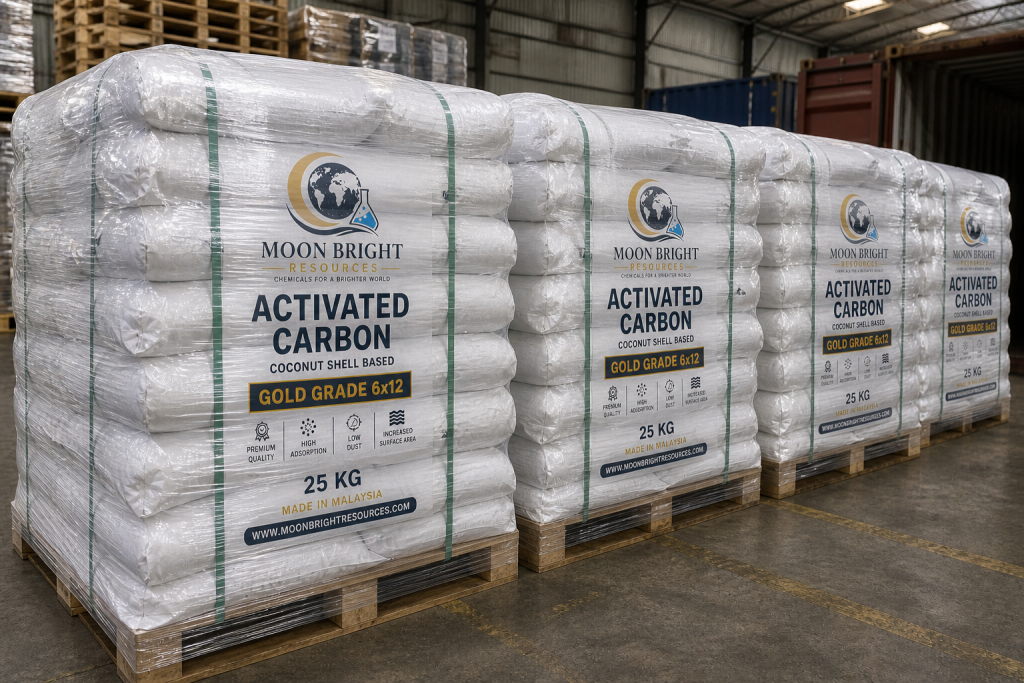
| Packaging Styles | $25 \text{ kg}$ Bags, $500 \text{ kg}$ Super Sacks | $25 \text{ kg}$ Bags, $500 \text{ kg}$ Super Sacks |
| Relative Attrition Risk | Extremely Low (High structural integrity) | Low to Moderate (More sensitive to handling) |
| Typical Lead-In Spec | ASTM D2854 (Apparent Density) | ASTM D2854 (Apparent Density) |
Minimizing Fines During Bulk Loading
Smaller mesh carbon particles have more edges and surface contact points, making them slightly more susceptible to structural chipping during bulk pneumatic conveying. When unloading 12×40 GAC into large steel pressure vessels, ensure that the supplier specifies a high ball-pan hardness (aim for $>98\%$ on high-quality coconut shell substrates).
This high hardness guarantees that the carbon will not degrade into fine powder during shipping and high-pressure installation, preserving the initial hydraulic design of your treatment facility. For direct procurement support and technical datasheets, visit our Coconut Shell Activated Carbon specs portal.
7. Frequently Asked Questions (FAQ)
Can I directly replace 8×30 GAC with 12×40 GAC in my existing filter system?
Not without evaluating your pump capacity and underdrain specs. While 12×40 GAC provides faster adsorption kinetics, it will double your pressure drop. If your pumps are not rated for this increased resistance, flow rates will decline. Additionally, ensure your underdrain screen openings are small enough ($<0.4 \text{ mm}$) to prevent the finer 12×40 GAC particles from leaking through.
Why does 12×40 GAC have twice the reaction speed of 8×30 GAC?
Reaction speed, or adsorption rate, is heavily dependent on the diffusion distance to the inner active pores. Because 12×40 particles are roughly half the volume of 8×30 particles, they have a larger external surface area per unit volume and a much shorter internal diffusion path, allowing contaminants to be captured almost twice as fast.
Does mesh size affect the total adsorption capacity of the carbon?
No. Mesh size only affects the physical particle size and the rate of adsorption (how fast it works). The ultimate adsorption capacity (how much contaminant it can hold at saturation) is determined by the internal pore structures (iodine value, pore volume) and the raw substrate material (such as coconut shell), not the external particle diameter.
What is the best mesh size for gravity-fed filters vs. pressure vessels?
Gravity-fed filters operate under low hydrostatic heads, making them well-suited for 12×40 GAC since the slower gravity flow accommodates the finer mesh without requiring high pressures. For high-pressure vessels operating at high hydraulic loading rates, 8×30 GAC is the industry standard to prevent excessive pressure buildup and system strain.
8×30 vs 12×40 activated carbon,
granular activated carbon mesh sizes,
B2B activated carbon suppliers Malaysia,
high-iodine activated carbon wholesale,
sourcing coconut shell activated carbon in bulk,
bulk activated carbon procurement guidelines,
municipal water treatment carbon specifications,
granular activated carbon wholesale bulk pricing,
activated carbon filter pressure drop calculation,
VOC removal efficiency of activated carbon,
regenerating granular activated carbon lifespan,
how activated carbon adsorbs heavy metals,
industrial water purification carbon standards,
AWWA B604 compliance water treatment,
food and beverage grade activated carbon specs,
commercial air filtration media procurement,
industrial water treatment chemical supply,
bulk adsorbent media sourcing options,
activated carbon bulk density and packaging specs,
difference between GAC and PAC,

 English
  French
  Arabic
  Spanish
  Bulgarian